2026-09-24
Essential Checks for Revision Rhinoplasty in Incheon: Songdo JK Withme
Songdo JK Withme explains the critical essentials of revision rhinoplasty in Incheon, focusing on accurate structural diagnosis, optimal timing, and autologous cartilage reconstruction.
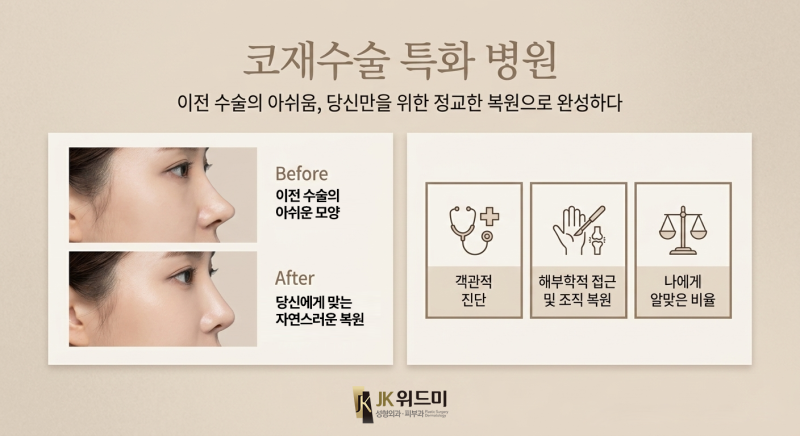

Revision Rhinoplasty: Breaking the Cycle of Failure with Precise Diagnosis and Natural Reconstruction
The nose sits at the center of the face and plays a pivotal role in defining three-dimensional facial balance. However, just like eye surgeries, revision rates for rhinoplasty are notably high. Experiencing dissatisfaction with the aesthetic outcome, encountering unexpected functional issues, or facing tissue deformation after surgery can take a heavy physical and psychological toll on a patient.
Simply aiming to "raise the nasal bridge again" must not be the objective. For successful revision rhinoplasty in Songdo, Incheon, one must identify the exact causes behind the previous failure and approach the procedure from a standpoint of "restoration" by precisely analyzing the internal nasal structures.

Why Is Revision Rhinoplasty More Challenging Than the Primary Surgery?
There are two primary reasons why revision rhinoplasty is technically demanding. First, the anatomical structure has been altered. In many cases, the septal cartilage has already been depleted from prior surgeries, or severe capsule formation around an implant (such as silicone) has caused the tissue to harden. Second, aesthetic concerns are frequently combined with functional complications. Rather than simply refining the exterior shape, surgeons often need to address functional issues affecting respiration, such as rhinitis or nasal valve collapse, simultaneously.
Therefore, revision surgery goes beyond cosmetic remodeling; it is fundamentally a "reconstructive surgery" designed to rebuild compromised structural support.
Common Types and Approaches in Revision Rhinoplasty
Every patient has distinct reasons for pursuing revision surgery. Because surgical strategies differ significantly depending on the case type, consulting a qualified specialist to evaluate your specific condition is paramount.
Revision Type | Key Symptoms & Causes | Corrective Solution |
Capsular Contracture | Nose hardens and pulls upward (short nose/upturned tip) due to infection or repeated procedures | Release scar tissue and lengthen the nose using autologous cartilage |
Aesthetic Preference Change | Bridge is too high or low; nasal line lacks facial harmony | Redesign the profile line tailored to individual facial proportions |
Implant Complications | Implant is visible or shifting; nasal bridge looks deviated | Remove previous implant and replace with autologous tissue or an appropriately fitted implant |
Functional Issues | Worsened nasal congestion or breathing difficulties after surgery | Septoplasty correction combined with functional structural reconstruction |
Cosmetic Dissatisfaction | Drooping nasal tip or nostril asymmetry | Reinforce tip projection support and reposition alar cartilages |
As outlined, revision rhinoplasty in Incheon requires thorough pre-operative analysis. In severe cases such as contracted noses where tissue damage is extensive, advanced techniques utilizing robust structural supports like costal (rib) cartilage are essential.

The "Golden Window" and Principles for a Successful Revision
Revision surgery cannot be performed at just any time. As a standard rule, a healing period of roughly 6 months to 1 year following the previous procedure is recommended, allowing the nasal tissues to stabilize fully and scar tissue to soften. However, if emergency circumstances arise—such as active, severe infection or impending implant extrusion—prompt surgical intervention may be required regardless of the timeline.
Furthermore, prioritizing the use of autologous tissues is significantly advantageous during revision procedures. Utilizing your own biological tissue—such as ear cartilage, septal cartilage, or rib (costal) cartilage—lowers the risk of implant rejection or infection and provides far more natural, enduring results.

Surgeon Expertise and Objective Proportional Analysis
It is no exaggeration to say that clinical experience accounts for more than 80% of successful revision outcomes. Until the surgical site is opened, it can be difficult to predict with complete certainty what materials were used previously or how severe internal scarring has become.
When selecting a clinic for revision rhinoplasty in Incheon, it is crucial to verify whether board-certified plastic surgeons—such as specialists trained at Seoul National University—with deep anatomical expertise and substantial experience in complex contracted nose reconstructions are performing the surgeries. Rather than simply chasing fleeting trends, your surgeon should be capable of offering an objective aesthetic evaluation tailored to your facial contours, nasolabial angle, and skin thickness.
The Right Mindset for Your Final Surgery
Patients who have experienced surgical failure often feel psychologically distressed, sometimes leading them to make overly conservative choices, or conversely, to chase dramatic transformations. However, the most successful revision surgery is one that restores the look that is most authentic and naturally harmonious to you.
Backed by extensive data accumulated across numerous revision cases, JK Withme aims to deliver customized surgical solutions that resolve both functional discomfort and aesthetic concerns. With the dedication of starting fresh and getting every detail right from the beginning, we provide in-depth consultations and precise surgical execution to ensure you never have to endure this worry again.
If you are struggling with ongoing concerns, we advise against making assumptions on your own. Schedule a clinic consultation to receive an accurate, professional assessment of your current nasal condition.
*View Before & After Photos*
Frequently Asked Questions
When is the best time to undergo revision rhinoplasty?
Generally, it is advisable to wait approximately 6 months to 1 year following the previous surgery. During this window, damaged nasal tissues achieve adequate stability and internal scar tissue softens. However, in emergency scenarios such as acute infection or implant extrusion, immediate surgical intervention is necessary regardless of the elapsed time.
Why is revision rhinoplasty more difficult than the primary procedure?
Because the anatomical framework of the nose has typically been altered, often accompanied by functional impairments. The septal cartilage may already be depleted, or scar tissue and capsules surrounding implants may cause significant hardening. Additionally, surgeons must frequently correct respiratory complications like rhinitis or nasal valve stenosis at the same time, demanding precision akin to reconstructive surgery.
How is a contracted nose (capsular contracture) corrected?
Correction involves releasing contracted scar tissue and lengthening the shortened nasal framework using autologous cartilage. Because tissue damage is severe in contracted noses where the tip is pulled upward due to recurrent inflammation or multiple surgeries, advanced surgical skills using robust autologous struts, such as costal (rib) cartilage, are required to firmly rebuild the nasal structure.
Is it better to use autologous tissue for revision rhinoplasty?
Yes, prioritizing autologous tissue offers clear advantages. Using the patient's own tissue—such as ear, septal, or rib cartilage—drastically reduces the risk of foreign body rejection and post-operative infection, yielding a significantly more natural and stable structural result.
Can breathing difficulties caused by a previous rhinoplasty be resolved through revision surgery?
Yes, functional structural reconstruction can effectively resolve these concerns. If post-operative complications such as septal deviation or nasal valve collapse have triggered nasal obstruction and labored breathing, revision surgery can address both aesthetic contours and functional defects simultaneously through septoplasty and internal structural restoration.